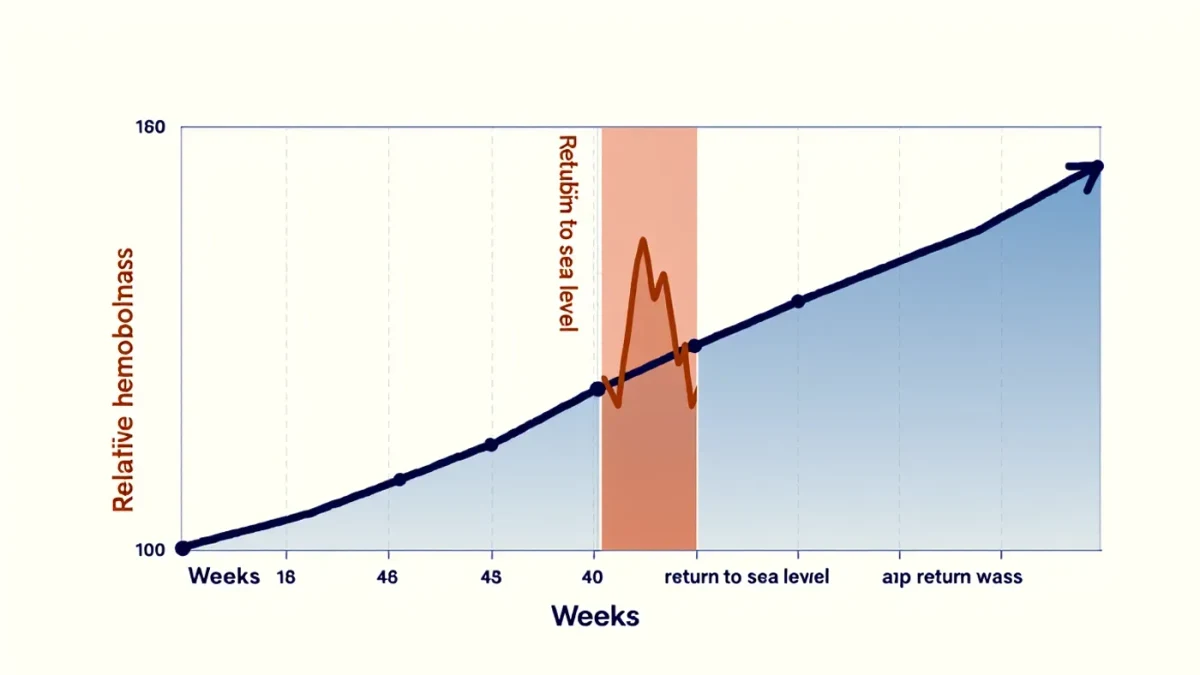
How does altitude training actually work? The short version: thin air stresses the kidneys into making more red blood cells, and more red blood cells carry more oxygen to working muscles. Athletes who sleep at moderate elevation — roughly 1,800 to 2,500 meters — for at least three to four weeks typically see a measurable rise in hemoglobin mass, the variable most directly tied to endurance performance. Everything else in the altitude-industrial complex, from hypoxic tents to simulated-altitude rooms, is an attempt to reproduce that stimulus without moving to the mountains.
What happens to the body at elevation, hour by hour?
Within hours of arriving at altitude, the oxygen sensor in the kidneys notices that oxygen-carrying capacity has dropped and releases erythropoietin, the hormone that tells bone marrow to build red blood cells. EPO levels can rise substantially within the first 24 to 48 hours, though the meaningful hemoglobin gains take weeks of continuous exposure to accumulate. Meanwhile the body makes faster adjustments: breathing rate climbs, blood plasma shifts, and the feeling of a given pace gets dramatically harder. That is the trade at the heart of every altitude plan — the adaptation happens while you sleep, but the training quality you can do at elevation is worse than at sea level.
Why does everyone say 'live high, train low'?
Because the two benefits pull in opposite directions. Living high delivers the blood-building stimulus; training low preserves the speed work that altitude degrades, since maximum oxygen uptake and muscle-function decline as elevation rises. The live-high-train-low model, formalized in influential research at the Dallas-based Institute for Exercise and Environmental Medicine and other altitude-research centers, showed athletes could get the hematological boost while keeping high-intensity sessions sharp. The practical problem is geography: you need a bedroom at 2,000 meters and a track near sea level, which is why places like the area around Park City, Utah, with canyons that drop thousands of feet within a short drive, became endurance-mecca real estate.
Do altitude tents and simulated hypoxia actually work?
They can, with caveats. Sleeping in a nitrogen-diluted tent that mimics 2,500-plus meters can produce hemoglobin-mass gains over several weeks, but the response varies widely between individuals — some athletes are strong responders, others barely respond at all, a pattern researchers have documented consistently in the altitude literature. The tents also demand real compliance: eight-plus hours a night, for weeks, in a stuffy enclosure. Many elite athletes decide the payoff does not justify the sleep disruption, which matters because sleep itself drives recovery. Intermittent hypoxic exposure — short bursts on a stationary bike breathing thin air — has far weaker evidence behind it and is mostly used as a supplement rather than a primary tool.
How long do the benefits last?
Not as long as athletes hope. The hemoglobin-mass gains from an altitude block begin fading within about two to three weeks of returning to sea level as EPO stimulus disappears and the extra red cells cycle out. That decay curve dictates competition planning: teams historically timed major championships for roughly one to three weeks after descending, the window where adaptation still outweighs the residual fatigue of the block. It also explains the endless debate about altitude training before events at altitude — arriving either well in advance, generally two or more weeks, or as late as possible, because the worst spot is landing in the middle, adapted to neither.
Is altitude training a doping shortcut in disguise?
The comparison gets made because the mechanism overlaps: synthetic EPO doping and natural altitude exposure both raise hemoglobin mass, which is exactly why anti-doping authorities spent years scrutinizing the practice. But altitude is legal and doping is not, and the biological passport era made the distinction enforceable by tracking athletes' blood values over time. The fairer critique is one of access. Altitude blocks and hypoxic tents cost real money, giving well-funded federations and professionals an edge over athletes from sea-level countries who cannot relocate for a month. It is not a banned advantage — it is an economic one, like better coaches or shoes, and endurance sport has decided that is a race it is willing to run.
Should a recreational runner bother?
Probably not with a tent, and definitely not with a fake altitude mask that just restricts breathing, which does not simulate altitude at all. For amateurs, the honest hierarchy is: consistent training, adequate sleep, sensible nutrition and iron status — altitude adaptation does not work without sufficient iron, since hemoglobin building is iron-dependent, and iron deficiency blunts the entire response. If a hobbyist happens to have a month in the mountains, the training camp itself can help simply through consistency. But the marginal gains of altitude belong to athletes who have already harvested everything else. For everyone else, thin air is a nice vacation with a physiological story attached.