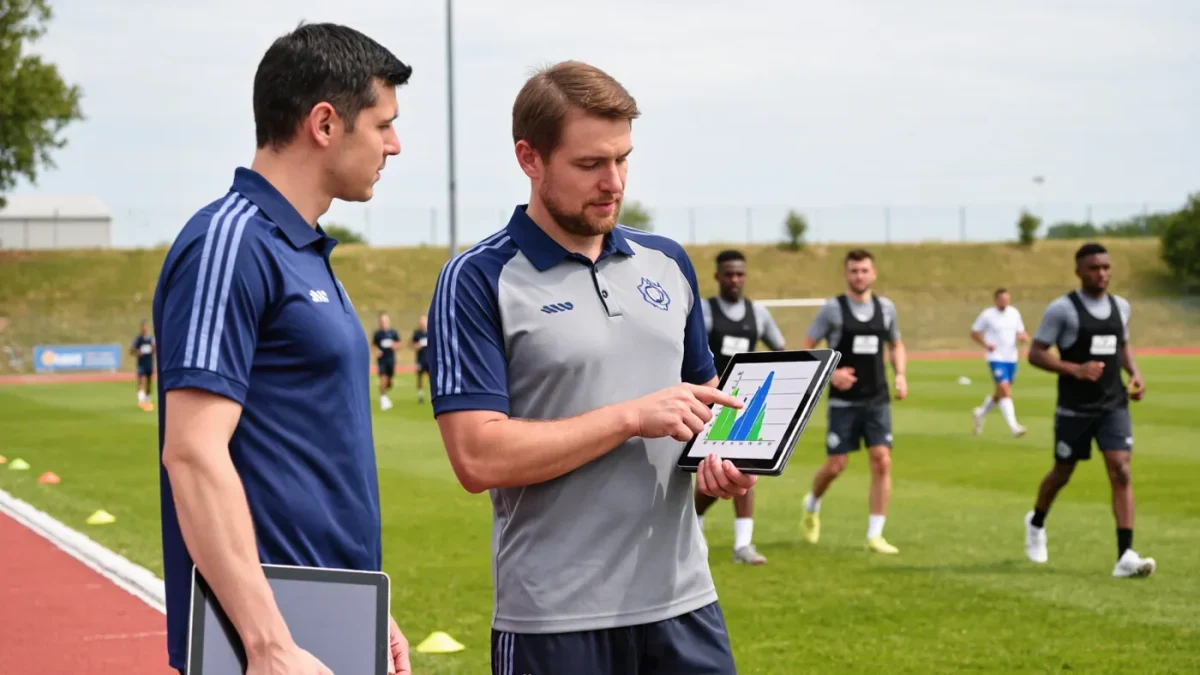
Why have NFL clubs finally embraced sports science? Because the numbers stopped being arguable. Every NFL roster now carries practice-load data collected by wearable GPS units that sample player movement hundreds of times per second, and over roughly the past decade the sport has shifted from trusting coaches' eyes on fatigue to trusting dashboards that track sprint distance, collisions and recovery in real time. The change was not philosophical. It was economic: a single starter lost to a soft-tissue injury can burn eight figures of salary cap space, and teams that could see risk earlier simply stopped handing games away to their own training rooms.
What does an NFL sports science department actually do all week?
The daily job is measurement and translation. Scientists collect GPS load, heart-rate variability, sleep and soreness reports, then compress it all into a color-coded readiness score that a position coach can read in ten seconds. During the season the week has a rhythm: Monday is damage assessment, Tuesday and Wednesday are about pulling loads down, Thursday and Friday ramp speed back up so players hit Sunday with exposed to high-velocity work. The craft is in the translation. A dashboard nobody understands is wallpaper; a good sports scientist survives in a building only if coordinators actually change practice plans because of the numbers.
Didn't the NFL resist this stuff for a long time?
It did, and the resistance had a culture behind it. Football tradition prized toughness and suspicion of anything that smelled like comfort, and for years wearables were seen as the province of European soccer, where clubs tracked players with GPS systems since the 1990s and early 2000s. The NFL's turn came through the collective bargaining agreement of 2011, which slashed padded practices and forced coaching staffs to ask an unfamiliar question: if we can't just hit more, how do we manage readiness? The league also began allowing player-tracking chips in shoulder pads for its own data pipeline, which normalized measurement league-wide. Once one team gained an edge, the arms race did the rest.
Is there real evidence load monitoring reduces injuries?
This is where honesty matters, because the evidence is promising but not settled. What is well established in exercise science is the relationship between acute spikes in training load and injury risk: when a player's weekly load jumps far above his recent average, soft-tissue risk climbs, a pattern documented across multiple team sports and reviewed in peer-reviewed sports medicine literature, including work indexed by the National Library of Medicine. What clubs privately concede is that no system prevents contact injuries, and most injuries in football are contact injuries. Sports science in the NFL is mostly about managing the preventable margin — hamstrings, groins, overuse — which is a smaller pie than fans assume but a meaningful one across a 53-man roster.
How do players feel about being tracked year-round?
Reactions split, and players hold real leverage through their union. Tracking during practice is collectively bargained and teams cannot use wearable data against players in contract negotiations, a line the NFLPA has defended carefully. Sleep and off-day data is usually player-owned, collected through team-issued apps that players can ignore. The veterans who buy in tend to be the ones who felt the alternative — the old hit-and-hope model — and watched teammates' careers shorten because of it. The skeptics worry about surveillance creeping into a job where roster cuts are already ruthless. Both instincts are reasonable, and the healthiest team cultures treat the data as a conversation starter with players rather than a verdict on them.
Does any of this actually show up on Sunday?
It shows up most visibly in fourth quarters and December. Clubs that manage load well believe they finish seasons with more available starters, and availability is quietly one of the strongest predictors of winning in a league engineered for parity. The also shows up in ways fans can spot once they look: the deliberate ramp of a wide receiver coming off a hamstring strain, the veteran starter taking midweek scout-team snaps instead of full-speed reps, the kicker who barely practices at all between games. None of it makes highlight reels. All of it is the difference between a 10-7 team and a 7-10 one in a sport where the margin is that thin.
What comes next for NFL sports science?
The next frontier is individualization. Teams are moving from roster-wide load rules toward per-player models that account for age, position, injury history and even travel schedules, and the clubs investing most heavily are treating readiness data like scouting data — a competitive asset. There is a caution worth stating: the field's literature is still young, sample sizes are small because rosters are small, and anyone promising injury prediction with certainty is selling something. But the direction is fixed. The NFL spent a century treating the body as a machine to be driven; it has finally accepted that the machine comes with instrumentation, and the teams reading that instrumentation earliest are the ones playing latest into January.