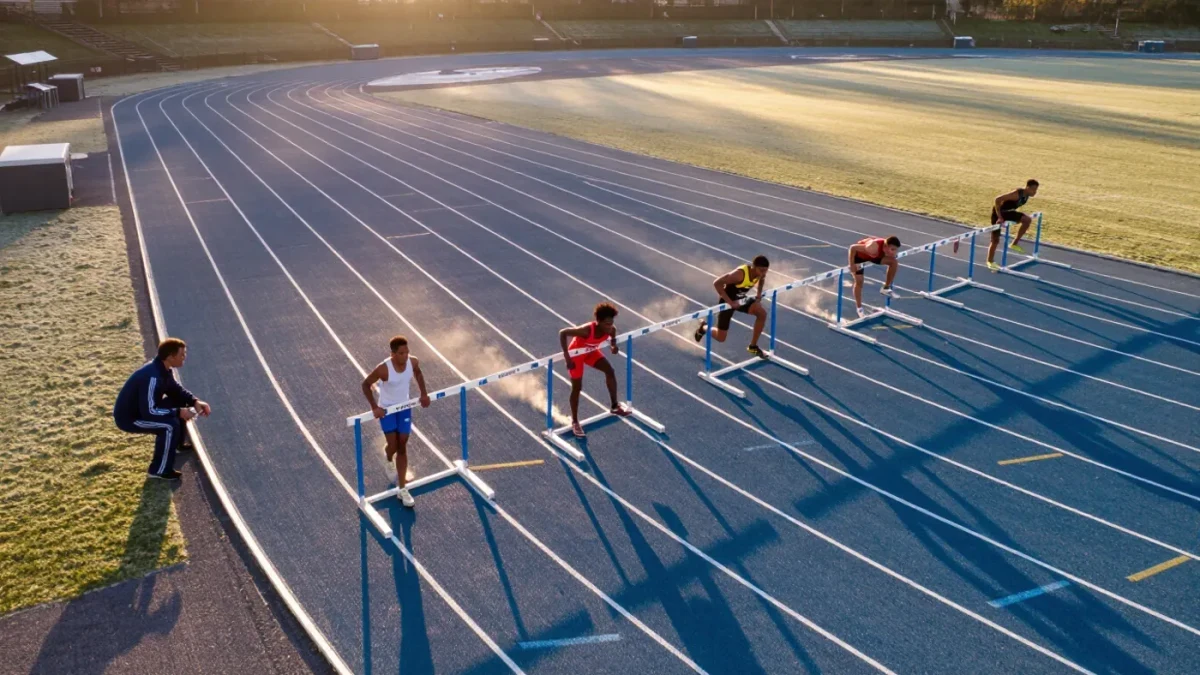
Sydney McLaughlin-Levrone keeps breaking records because she is, in the most literal sense, the only measuring stick she has left: she has lowered the women's 400-meter hurdles world record six separate times, most recently to 50.37 seconds at the Paris Olympics in 2024, a time so far beyond the field that the rest of the Olympic final was racing for silver from the gun. In a discipline where progress is usually measured in hundredths across generations, she has taken more than a second and a half off her own era. The rest of the world's hurdlers are not chasing her. They are chasing the version of her from two years ago.
How did the record-breaking start?
She announced the possibility early. As a 16-year-old in 2016, McLaughlin made the U.S. Olympic team and became the youngest American track athlete to qualify for the Games in decades. She reached a Rio semifinal, then matured through a collegiate season at Kentucky and into the professional ranks under coach Bob Kersee — the pairing that would define everything after.
The record assault began at the 2021 U.S. Olympic Trials, where she ran 51.90 to break the world record for the first time, and then, weeks later at the Tokyo Olympics, took it down again with 51.46 while winning gold. Two records in one summer, at 21 years old, was already a career. It was the overture.
What happened in 2022 and beyond?
The world championships in Eugene in 2022 delivered the first sub-51-second race in history: 50.68, a record many in the sport described as generational. She then missed the 2023 world championships season while restructuring her training and racing program — and returned in 2024 sharpened rather than diminished. At the U.S. Trials she broke the record again, and in Paris she ran 50.37, breaking her own Olympic record with the fastest 400m hurdles race ever by a woman, and adding world-title credentials to her résumé.
Each lowering has followed a similar pattern: a season of technical recalibration — stride pattern changes, rhythm adjustments between hurdles — followed by a single night where the arithmetic lands all at once.
Why is the 400m hurdles so hard to master?
Because it is a negotiation between two incompatible demands. Raw speed destroys hurdle rhythm; perfect rhythm wastes speed. The race requires ten barriers spaced at fixed intervals, with athletes choosing a step count — 14, 15 or 16 strides between hurdles — that must hold under accumulating fatigue. When the stride pattern breaks in the final 100 meters, the race collapses.
McLaughlin-Levrone's advantage is a rare combination: flat-400 speed fast enough to win national-level open races — she has dipped well under 50 seconds in the flat 400 — attached to hurdle technique so clean that her lead leg barely interrupts her sprint. Most hurdlers trade one for the other. She spends both.
Is she really only racing herself?
The statistics say yes. When she ran 50.68 in 2022, the second-fastest woman in history was more than half a second behind — an enormous margin in a race lasting 51 seconds. In Paris in 2024 she won by daylight, with the silver medalist over a second back. Her personal-best progression now sits more than a second clear of every other woman in history.
The competitive consequence is strange: she experiences the existential condition of the solo leader, where records substitute for rivals. Her post-race reflections have consistently framed it in faith terms — she has spoken and written extensively about running for purposes beyond medals — which functions, athletically, as the psychology that makes such dominance sustainable.
What does her relay work add to the case?
Range. McLaughlin-Levrone has also anchored American 4x400m relay teams to Olympic gold — in Tokyo and again in Paris — and world titles, running legs that rank among the fastest relay splits ever recorded by a woman. The relay golds give her five Olympic golds across two Games, and her ability to drop into a flat 400 at world-class level confirms that the hurdle records are built on a chassis, not a trick.
What does her training approach look like?
Deliberately old-school, by the standards of her event. Under longtime coach Bob Kersee she has trained alongside some of the great American hurdlers and sprinters in a group environment built on repetition, technical drilling and racing discipline rather than constant competition. Her seasons are structured around a small number of peak targets — the U.S. championships, worlds or the Olympics — with long uninterrupted blocks of work spent refining stride patterns between the barriers and sharpening raw speed in the flat 400, her preferred laboratory for building the engine that the hurdles race then expresses.
The pattern of her record runs reflects that architecture: she often opens a season conservatively, drops her times through early summer, and then delivers the arithmetic on the single night the plan was built around. Records, in her case, are not accidents that happen during racing. They are projects with schedules, engineered months in advance and executed with the composure of a time trial against history rather than a race against people.
What comes next for her?
The horizon includes more record attempts in her signature event and continued exploration of the flat 400, where her best times already place her among the fastest Americans ever. The structural fact of her career — that the world record is hers to attack — means every championship final is simultaneously a race and an audit of how much arithmetic is left.
How should we understand what she is doing?
Compare eras carefully: the women's 400m hurdles record stood for decades in the hands of greats before her generation attacked it, and the event's overall level has genuinely risen. But McLaughlin-Levrone's six record performances are not the tail of a distribution; they are a different distribution. She has taken the event somewhere it has never been, one deliberate recalibration at a time.
The rest of the world runs the women's 400m hurdles. She runs her own event.