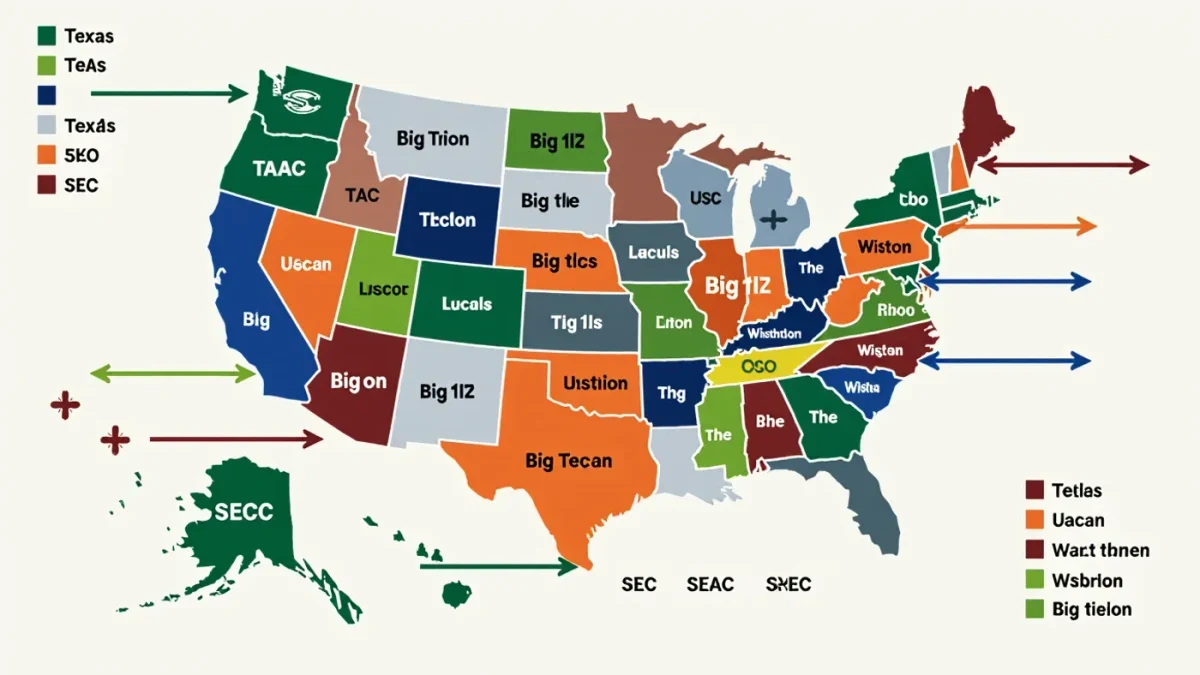
Conference realignment broke college sports' oldest rivalries because the sport's leaders finally stopped pretending tradition was an asset class. In the summer of 2024, the landscape detonated on schedule: Texas and Oklahoma joined the SEC, USC, UCLA, Oregon and Washington joined the Big Ten, and the Big Ten alone began collecting on a media deal reported at roughly $7 billion over seven years. Meanwhile the Pac-12 — a conference founded in 1915 in its earliest form — collapsed to two members, Oregon State and Washington State, after its remaining schools fled to the Big Ten, Big 12 and ACC. Rivalries that ran on shared buses and shared contempt for a century now require coast-to-coast flights, if they exist at all. That is not a side effect of realignment. It is the mechanism.
What Actually Happened in 2024?
The moves were years in the making — USC and UCLA announced their Big Ten jump in June 2022, and Texas and Oklahoma committed to the SEC back in 2021 — but everything landed at once in August 2024. The Big 12, itself rebuilt after losing Texas and Oklahoma, replaced them with Arizona, Arizona State, Colorado and Utah from the collapsing Pac-12. Stanford and California, stranded by their conference's implosion, landed in the ACC alongside SMU. The Pac-12's remains — Oregon State and Washington State — were left scheduling as a de facto independent two-hander, winning a court fight for control of conference assets along the way. In one offseason, the regional logic that organized college sports for over a century was fully replaced by media-market logic.
Why Did the Money Beat the Rivalries?
Because the gap was enormous and widening. The Big Ten's deal with Fox, CBS and NBC — reported around $7 billion over seven years, beginning in 2023 — pays each member tens of millions annually, numbers that dwarf what the Pac-12 could command after its own media negotiations collapsed, which is precisely when the exodus began. Conference commissioners work for their member schools, and member schools answered a simple question: what is a rivalry worth in dollars? The honest answer, in a revenue-sharing era where athletic departments pay players directly following the 2025 House v. NCAA settlement, was that no annual game against a historic rival could justify leaving nine figures of media money on the table. Once one brand-name school treated geography as optional, every conference had to expand or die. The rivalry died in the crossfire not because anyone hated it, but because no one could afford to save it.
Which Rivalries Actually Died?
The clearest casualty is Bedlam — Oklahoma versus Oklahoma State, played continuously for over a century — which ended when Oklahoma left for the SEC in 2024, with the schools admitting the series had no scheduled future. Others survive in weird, wounded forms: Kansas and Missouri, separated since 2012, have scheduled non-conference meetings; the Arizona schools kept their Territorial Cup by moving to the Big Ten-free Big 12 together; USC and Notre Dame, mercifully, maintained their intersectional series because it was never conference-bound in the first place. But the everyday texture is gone. Oregon and Washington, whose rivalry decided Pac-12 titles for a decade, now meet as West Coast outposts of a midwestern-and-mid-Atlantic conference. Texas and Texas A&M's rivalry resumed in 2024 only because both schools ended up in the SEC — realignment giveth back what realignment took in 2012. The survivors are the ones that fit somebody's TV inventory.
What Did It Do to the Athletes?
A scheduling tragedy dressed as a logistics problem. USC volleyball and soccer teams — Olympic-sport athletes with classes — fly across three time zones for weeknight conference games in New Jersey and Maryland, because the conference that sells football television inventory also sets the schedule for everyone else. A UCLA softball player's conference road trips went from bus rides to red-eyes. Football players lose Saturdays to travel and recovery. The athletes most affected by realignment are the ones whose sports generate none of the money that caused it — a familiar pattern in college sports, but now with jet lag. Athletic departments hired nutritionists and sleep consultants to manage the new geography, which tells you everything: the solution to realignment's costs was not fewer flights, it was better coping with them.
Can Any of It Be Put Back Together?
Not really, and the next wave may make it worse. The ACC's grant-of-rights binds its members — including the West Coast additions — into the 2030s, and any further reshuffle (an escalating revenue gap inside the ACC, say, or a super-league push from the biggest brands) would break rivalries again. The optimists' case is nostalgia as product: non-conference scheduling agreements, rivalry-week exemptions, and conferences protecting annual crossover games the way the SEC preserved some interdivision series for decades. The realists' case is that college football has simply become a minor league with a century of branding, and branding survives relocation — ask any NFL fan of a team that moved cities. What cannot survive is the premise that college sports were ever regional by anything other than accident. Realignment proved the accident, cashed it in, and left the rivalries as souvenirs.