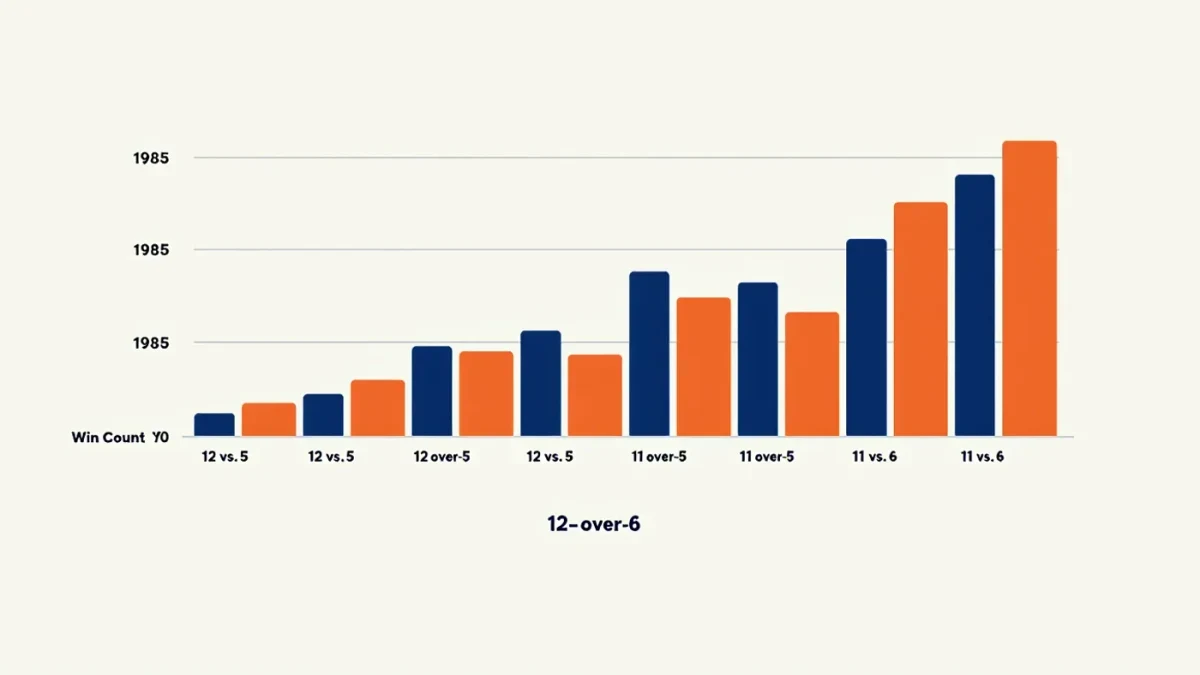
March Madness upsets are not pure noise. Since the men's tournament expanded to 64 teams in 1985, a 16 seed has beaten a 1 seed exactly twice — UMBC over Virginia in 2018 and Fairleigh Dickinson over Purdue in 2023 — while the 12-over-5 upset has become so reliable that fans budget for it the way they budget for taxes. The pattern is real, and it comes from a short list of repeatable causes: roster experience, stylistic friction, and the simple mathematics of one game in March.
Why Do 12 Seeds Beat 5 Seeds So Often?
Start with the seeding math. The selection committee's 5 seeds are usually power-conference teams with flaws — often ones that limped in or rely heavily on freshmen — while 12 seeds are frequently mid-major champions or hot power-conference teams that peaked late. The talent gap between the two lines is among the smallest on the bracket, while the pressure gap runs the other way: the 5 seed is supposed to win, and everyone in the gym knows it.
There is also a stylistic layer. Mid-major champs tend to be old, cohesive rosters that have played together for three or four years and run one system flawlessly. A single-elimination game is a small sample, and small samples reward the team that controls tempo and margins — turnovers, free throws, shot selection — rather than the team with more future NBA draft picks.
What Makes a True Cinderella Run?
The deep runs follow a script. Look at Saint Peter's in 2022, a 15 seed that reached the Elite Eight, or Florida Gulf Coast's Dunk City sprint to the Sweet 16 in 2013. The common threads: an elite defense or a uniquely physical style that opponents couldn't simulate in one day of preparation, veteran guards who never sped up, and a coach willing to shorten the game.
Preparation asymmetry matters more than people think. In the first round, the power-conference team is preparing for an opponent it barely scouted, while the mid-major has spent months watching film of programs it measures itself against. One day of practice is not enough to close that.
Do Upsets Cluster in the Early Rounds?
They do, and the structure of the tournament explains it. The first round offers 32 games, most of them mismatched on paper, which is where variance gets its chances. By the Sweet 16, the survivors are either genuinely good or playing with house-money confidence — but the field has thickened, the scouting reports have evened out, and Cinderella's edge in surprise is gone.
That is why the second weekend produces fewer upsets per game, but the ones that land — like Saint Peter's beating Purdue to reach the Elite Eight — feel seismic. Each round filters out the flukes and leaves the upsets built on sustainable advantages.
Can You Predict Which Upsets Are Coming?
You can narrow the field, not pick the winner. The checklist the data has favored for decades: favor the experienced roster over the freshman-laden one; favor teams that defend and control the ball over teams that merely shoot well, because shooting travels worse; favor coaches with tournament reps; and treat any 12-5 matchup with a pace mismatch as live. Two of those signals together are worth more than any seed line.
What you cannot do is out-model a single basketball game in March. The tournament's charm is that the pattern describes the forest, and every spring the trees keep doing something nobody scanned.
Why Do We Remember the Upsets More Than the Winners?
Because the upset is the tournament's thesis statement. The champions are usually the predictable part — since 1985, no team worse than an 8 seed has won the men's title, and the winners cluster heavily among the top three seed lines. The chaos lives in weeks one and two. March Madness sells order being briefly, gloriously suspended, and the pattern of that suspension is what keeps otherwise rational adults filling out brackets at their desks.
The upsets rhyme. They are not random. They are just rare enough to stay magical.
Do the Women's Bracket Upsets Follow the Same Rules?
Mostly, with one fascinating wrinkle: the women's tournament produced a 16-over-1 before the men's did. Harvard beat Stanford in 1998, twenty years before UMBC managed it on the men's side — proof that the upset pattern is structural, not gendered. The women's bracket has historically been even more top-heavy at the very top lines, where dynastic programs sometimes hold overwhelming talent advantages, but the middle seeds produce chaos at familiar rates.
The same predictors travel across brackets: veteran rosters, defensive reliability, experienced guards, and a style opponents cannot replicate in one practice. The mechanics of a single-elimination upset don't care which bracket you are in. That is precisely why filling out two pools in the office has become the default March format.